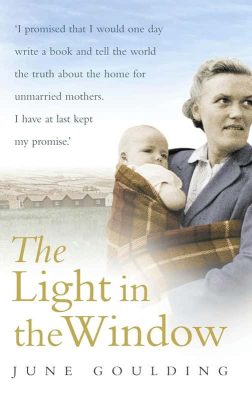
Title: The Light in the Window
Author: June Goulding
Major Themes: Memoirs, Midwifery, Ireland
Synopsis: When a young midwife accepted a position in a home for unmarried mothers in early 1950s Ireland, she had no idea of the amount of heartache, sorrow, and unlikely friendships she’d discover through her work.
Several years ago, I picked up a copy of The Light in the Window while going on a garage sale outing with a friend. It looked vaguely interesting at the time, but it ended up going on the shelf eventually, unread, even though I was hopeful I’d get to pick it up sometime. After a while, when the shelves were starting to feel rather cramped, it ended up joining my stack of possible culls—books I wanted to read to decide if they deserved to stay or not. I’m so glad I finally got around to picking this book up! Even though it was a difficult read, in some respects, it was also written in a gripping way, and I couldn’t help but sympathize with the girls’ plights described in the story.
Publisher’s description:
‘I promised that I would one day write a book and tell the world about the home for unmarried mothers. I have at last kept my promise.’
In Ireland, 1951, the young June Goulding took up a position as midwife in a home for unmarried mothers run by the Sacred Heart nuns. What she witnessed there was to haunt her for the next fifty years. It was a place of secrets, lies and cruelty. A place where women picked grass by hand and tarred roads whilst heavily pregnant. Where they were denied any contact with the outside world; denied basic medical treatment and abused for their ‘sins’; where, after the birth, they were forced into hard labour in the convent for three years. But worst of all was that the young women were expected to raise their babies during these three years so that they could then be sold—given up for adoption in exchange for a donation to the nuns.
Shocked by the nuns’ inhumane treatment of the frightened young women, June risked her job to bring some light into their dark lives. June’s memoir tells the story of twelve women’s experiences in this home and of the hardships they endured, but also the kindness she offered them, and the hope she was able to bring.
My thoughts:
It’s hard to imagine people treating others the way they were in this book. It’s also hard to comprehend how much things have changed for unmarried women over the past 70 years. And then to think that a young woman in her early 20s was thrust into a position like this, with little context to go on as she tried to help these girls and women…and with hardly any medical supplies, love, or compassion from those who were in charge and should have been the most caring. It’s almost hard to believe the story, but at the same time, it rings true. It was encouraging to see June trying to love and show kindness, even when it put her job on the line, and especially to see what a difference it made for these women.
One thing that I struggle with in books like this is the way so-called Christian’s actions can cast a bad light on the Name of Jesus. In this story, one woman, especially, called herself a Christian but did very little to help those in need—and often did more to harm (in a twisted attempt to “teach them a lesson”) than help them. That was hard to read about, but at the same time, the contrast between her actions and attitudes and those of others who had compassion was strikingly obvious.
I found The Light in the Window compelling, insightful, and a gripping portrait of another time and place not that removed from today’s world. It was difficult to imagine how these women survived—and what their lives may have been like after going through the experiences described here. It has given me more compassion for those who are struggling with different things, whether they brought it on themselves or not, and has reminded me how far a little kindness can go. This isn’t a Christian story, necessarily (Catholicism is mentioned throughout, but that’s never dwelt on), but it is the story of hope and kindness amid despair. Recommended, if you enjoy true stories and memoirs from history, or medical stories. I wasn’t sure if I wanted to keep this book on my shelf before I started it, but I’m planning to now—it’s a good book!
WARNING: There are occasional mentions of attending births, dealing with different health issues women face, procedures done for pregnant women, birth-related injuries, or other injuries. Unmarried characters hold hands, hug, or kiss occasionally—never described. Several times, there are descriptions of watching children being ripped away from their mothers (as well as general cruelty about the way mother/child relationships were handled in the home). The setting is strongly Catholic, so there are mentions of going to confession, having Mass, praying the rosary, etc. Several times, there are mentions of hard work the pregnant women and new mothers had to do—like hand-plucking the grass to mow it, or tarring the driveway. One person was often quite cruel to the women, treating them without any love or compassion.
“Thank God” is used in a not-so-reverent way in ch. 2; “Jesus” is used wrongly in ch. 3, 11 (twice), and 15; “what in God’s name” is used in ch. 3; someone is called a “bitch” in ch. 7, 11, and 16; “for God’s sake” is used in ch. 9; “my God” is used in ch. 9, 16, and 17; God is used as an exclamation in ch. 12 (twice), 15 (twice), and 19 (twice); “I swear” is used in ch. 12; goodness is used in ch. 15; “please God” is used in a not-so-reverent way in ch. 15; “by God” is used in ch. 16; and “what the hell” is used in ch. 17. There is lying in ch. 6, 7, 9, 11, 17, and 18.
Sexual intercourse is mentioned in ch. 6, as a girl talks about the circumstances in which she got pregnant (not described; she just gives the bare bones of what happened). Incest is mentioned in ch. 7. In ch. 8, there’s a mention that two girls were pregnant by the same man (who had taken advantage of them), and a girl goes crazy and tries to hurt someone. In ch. 12, there’s a mention of someone who tried to drown herself, a baby is stillborn, and someone threatens to drown themselves. In ch. 14, five girls realize they are all pregnant by the same man. Someone gets a sewing machine needle through her finger in ch. 18. There are a few other stories scattered throughout of how the girls got pregnant, but it never goes into the nitty-gritty details (usually just a paragraph or two). Smoking is mentioned a couple of times.
Age levels:
Reading Independently—Adults
Links to buy this book:
Amazon: Paperback | Kindle
AbeBooks: View Choices on AbeBooks.com




Leave a Reply