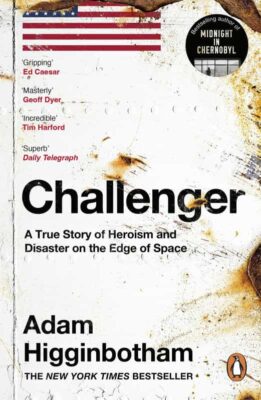
Title: Challenger: A True Story of Heroism and Disaster on the Edge of Space
Author: Adam Higginbotham
Major Themes: Disasters, Tragedies, United States, NASA, Space Travel, Space Program
Synopsis: A gripping retelling of the Challenger space shuttle disaster and the events in history leading up to the accident.
I enjoyed (enjoyed? not sure that’s the right word, but anyway) reading Midnight in Chernobyl last year. I’ve discovered I have a somewhat morbid fascination with disaster and survival stories. Since that book was so fascinating, when I came across a mention of Challenger, I knew I wanted to read that, too. It’s an event I heard about years ago, but the details were pretty fuzzy, so I finally borrowed it from the library and listened to it.
Publisher’s description:
From the New York Times bestselling author of Midnight in Chernobyl comes the definitive, “compelling, and exhaustively researched” (The Washington Post) minute-by-minute account of the Challenger disaster, based on fascinating and new archival research—a riveting history that reads like a thriller.
On January 28, 1986, just seventy-three seconds into flight, the space shuttle Challenger broke apart over the Atlantic Ocean, killing all seven people on board. Millions of Americans witnessed the tragic deaths of the crew, which included New Hampshire schoolteacher Christa McAuliffe. Like the assassination of JFK, the Challenger disaster is a defining moment in 20th-century history—one that forever changed the way America thought of itself and its optimistic view of the future. Yet the full story of what happened, and why, has never been told.
Based on extensive archival research and meticulous, original reporting, Challenger: A True Story of Heroism and Disaster on the Edge of Space follows a handful of central protagonists—including each of the seven members of the doomed crew—through the years leading up to the accident, and offers a detailed account of the tragedy itself and the investigation afterward. It’s a compelling tale of ambition and ingenuity undermined by political cynicism and cost-cutting in the interests of burnishing national prestige; of hubris and heroism; and of an investigation driven by leakers and whistleblowers determined to bring the truth to light. Throughout, there are the ominous warning signs of a tragedy to come, recognized but then ignored, and later hidden from the public.
Higginbotham reveals the history of the shuttle program and the lives of men and women whose stories have been overshadowed by the disaster, as well as the designers, engineers, and test pilots who struggled against the odds to get the first shuttle into space. A masterful blend of riveting human drama and fascinating and absorbing science, Challenger identifies a turning point in history—and brings to life an even more complex and astonishing story than we remember.
My thoughts:
What a story! I’ve read books about the space missions of the 60’s, 70’s, and 80’s before—most recently, I enjoyed Hidden Figures—but Challenger took those stories to a whole new level. Higginbotham does a great job at bringing us into the times and places of his subjects, and also manages to explain technical details in a way that even with a basic layman’s understanding of things, I’m able to understand it—that takes skill!
One thing that impressed me in Chernobyl, and again to some extent in Challenger, was the way Higginbotham managed to craft mini biographies of all the main players in the story in such a way that I could remember who each person was when their name came up again. This story had a lot more key people to keep track of, so I struggled to remember some people’s backgrounds, but I still felt Higginbotham did a great job of not just telling the facts but telling people’s stories—that was impressive!
As the book promises, this is a play-by-play account of the disaster, but it also tells so much more. It’s almost more of an overview of the US’s entire space mission history than just about this singular disaster, because many of the decisions made early in the 1960s had long-lasting repercussions into more modern space achievements. I found that fascinating to learn about, and a day or two after finishing this book, when I came across a newspaper article talking about some astronauts who recently returned from space, it felt like I was reading about old friends—or at least locations that felt much more familiar than they did before reading this book!
My only complaint about the book? The language. As you will see below, it wasn’t that great at times—but in my opinion, it’s likely a fairly realistic representation of lingo at the time.
If you’re interested in learning about the Challenger disaster, I’d highly recommend you check out this book. Since I listened to the audiobook, I have no way of checking to see what the bibliography section of this book looks like (or if there is one), but it feels like that should be pretty impressive—there’s an amazing amount of detail in this story, but somehow, it’s all presented in a very readable format. I’m definitely looking forward to checking out more of Adam Higginbotham’s books in the future, if I get the chance!
WARNING: Chapter 6: Fucking. Chapter 7: Fucking. Chapter 8: Jesus Christ, son of a bitch. Chapter 9: I’ll be damned, for Christ’s sake. Chapter 10: You’ve got to be shittin’ me, use of slang to say you shouldn’t sleep around, mention of people having affairs with workmates, bullshit. Chapter 12: Shit. Chapter 13: Heck. Chapter 14: Holy shit, fucking. Chapter 16: Damned. Chapter 17: For Christ’s sake. Chapter 18: Shit. Chapter 19: Damn, go to hell, God. Chapter 20: Who the hell. Chapter 22: My God. Chapter 23: Damn, God, I hope not, shit. Chapter 24: What the hell, fucking, where the hell, God Almighty. Chapter 26: God. Chapter 28: My God.
Age levels:
Reading Independently—Adults
Links to buy this book:
Amazon: Paperback | Kindle | Hardcover | Audible Audiobook (unabridged)
AbeBooks: View Choices on AbeBooks.com





Leave a Reply