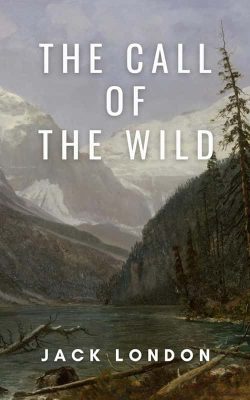
Title: The Call of the Wild
Author: Jack London
Major Themes: Dogs, Klondike Gold Rush
Synopsis: After being stolen from his home, Buck is thrust into the harsh, unfamiliar world of the Klondike Gold Rush.
One of my goals over the next few years is to get through a few more classical works than I have in the past, so when I saw that The Call of the Wild fit that goal as well as fitting nicely into a reading challenge I was doing, I decided to give it a shot. Although I appreciated a good amount of the story, it didn’t end up being a great classical work, in my opinion.
Publisher’s description:
The Call of the Wild is a short adventure novel by Jack London published in 1903 and set in Yukon, Canada, during the 1890s Klondike Gold Rush, when strong sled dogs were in high demand. The central character of the novel is a dog named Buck. The story opens at a ranch in Santa Clara Valley, California, when Buck is stolen from his home and sold into service as a sled dog in Alaska. He becomes progressively feral in the harsh environment, where he is forced to fight to survive and dominate other dogs. By the end, he sheds the veneer of civilization, and relies on primordial instinct and learned experience to emerge as a leader in the wild. London spent almost a year in the Yukon, and his observations form much of the material for the book.
The story was serialized in the Saturday Evening Post in the summer of 1903 and was published a month later in book form. The book’s great popularity and success made a reputation for London. As early as 1923, the story was adapted to film, and it has since seen several more cinematic adaptations.
My thoughts:
I came away from The Call of the Wild with mixed feelings. This is a well-written book. It has enough adventure to keep you on the edge of your seat, but not so much that it feels like danger just for excitement’s sake. I appreciated the glimpse into Canadian history at the time of the Klondike gold rush as well; it’s fascinating to think about what that may have been like for the dogs at that time, as well as for the people—it was a rough life!
I had some major beefs with the story, however. One of the biggest things, that surprised me at its frequency, was how many times evolution, and especially cavemen, featured in the story. The author has the dog staring into the fire multiple times, “seeing” what his ancestors “would have seen”—half-men/half-apes, doing things with their dogs…I found it all quite annoying, as I believe there is no scientific evidence that any of it could possibly be true. The other thing I struggled with was the believability factor. Several times, things happened, and I was left scratching my head wondering if it could happen that way in real life…who knows?
In the end, while it’s satisfying to say I’ve read this book, The Call of the Wild is a book I doubt I’ll ever read again. It’s got a lot of violence in it, the evolution factor is off-putting, and overall, it’s not the kind of book I tend to enjoy all that much. I found it interesting from a historical perspective; some of the history featured here may be similar to what actually happened, but other than that, I didn’t enjoy this read.
WARNING: “Sacredam” is used in ch. 1 and 3; “dam” is used as a curse word in ch. 1 and 3; “hell” is used in ch. 2, 3, 4, and 6; “by gar” is used in ch. 3 and 4 (twice); “good Lord” is used as an exclamation in ch. 5; “py jingo” is used in ch. 6 and 7; and “gad, sir” is used four times in ch. 6. A dog is stolen and there is lying in ch. 1. Dogs are often beaten and mistreated in the story. Almost every chapter has a dog fight where one (or more) dogs are killed, and frequently, people are forced to kill dogs that get too weak to go on. People fall through the ice and drown in ch. 5. A dog attacks a man and rips his throat open in ch. 6, and in ch. 7, a dog comes across a camp where Indians had raided and killed multiple people and animals (pretty gruesome). Four or five times in the story, the dog “remembers” back to the time of supposed cave-dwellers and “seeing” a short-legged hairy man who “could spring up into the trees and travel ahead as fast as on the ground, swinging by arms from limb to limb.…” In other words, evolution is a commonly-promoted topic in this book.
Age levels:
Reading Independently—Ages 12 – 15, 15 and Above, Adults
Links to buy this book:
Amazon: Paperback | Kindle | Hardcover | Audible Audiobook (unabridged) | Audio CD (unabridged)
AbeBooks: View Choices on AbeBooks.com


Leave a Reply