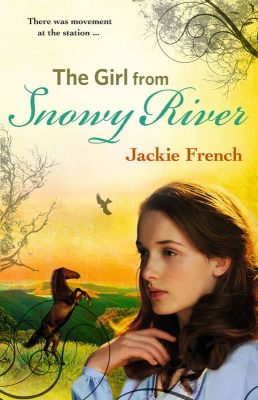
Title: The Girl from Snowy River
Author: Jackie French
Series: The Matilda Saga, book 2
Major Themes: Farming, Australian History, World War I, PTSD
Synopsis: After losing her parents and a brother in the Great War, Flinty McAlpine is doing her best to keep her family together and on the land she loves.
Over two years ago, while I was living with a family helping their severely disabled daughter, she got onto listening to the Matilda Saga series. I don’t think she went beyond the second book, The Girl from Snowy River, and though I’m fairly sure I heard most of the book, I recently went back and re-listened to the story. I’ve appreciated Jackie French’s writing style for years. Even though she isn’t a Christian, and there are occasionally off-color references in her works, I like the way she brings you into the setting and helps you to value both the historical era the book is set in and the natural beauty of Australia that is featured in the books in this series. Now, granted; I have only heard the first two books in this series, so my opinion may yet change, but so far, I have enjoyed a lot of things in these two books.
Orphaned after the war, sixteen-year-old Flinty McAlpine is determined to keep her family together and keep everything running smoothly—the way her father always did. She loves her place on the mountain, despite the difficulty her family has in keeping anything profitable growing on the land. And now that the war is over, she has high hopes that her family will be put back together again—as much as can be expected—and that they can move forward. The Great War did more than just take her two parents and brother, though—her brother Andy couldn’t stand to stay at home, and he left to go droving, and her childhood sweetheart Sandy will barely talk to her now, even though they exchanged many letters while he was away. Despite all of that, Flinty is determined to do her best for her two younger siblings, and when the opportunity to take part in a brumby muster comes up, she realizes she must try to join in to earn the money they need to keep the farm going and her family together. Will she be able to ride well enough to earn what they need? Will their family ever feel whole once more?
The Girl from Snowy River, while based on some of the beautiful poems from Australian history, is a form of poetry itself—an ode to the Snowy Mountains and the people that live in and around that beautiful, rugged area of Australia.
I loved the setting, loved the writing style, and basically loved everything about this book…except for two things. One, this isn’t a Christian story, so non-Christian attitudes come through at times (feminism is a strong theme throughout the story). And two, this book featured a ghost from the future that would come and encourage Flinty in some of the difficult things she had to do. Neither of those bothered me too much, but together, I was a little disappointed in this story.
Besides that disappointment, though, this book was such a great story of hope, perseverance, patience, love, kindness, hard work, and healing from painful circumstances. Without the love of Christ, the themes of hope and healing weren’t as powerful (as characters tried to find the answers themselves), but it’s still a gripping portrait of a past era and the struggles many Australians faced after the First World War.
I enjoyed getting to read The Girl from Snowy River for the most part, and I’m hoping to take the time to listen to more books from this series in the future—we’ll see! There are so many books to choose from! If you enjoy historical fiction that has rich characters and delightful settings, this could be a good choice for you.
WARNING: Throughout the book, a girl talks to a ghost (a man who time travels from the future), there are occasional mentions of drunkards, and a decent amount of feminist ideas come through. People who were badly injured in war are described in ch. 1. There are descriptions of war and people being killed or badly injured, often graphic, in chapters 7, 16, 18 (an especially bad one), 19, and 38 (another bad one). There are some descriptions of kisses between an unmarried couple in ch. 2, a man tries to kiss a woman he wasn’t married to in ch. 20, a man mentions how he spent his leave from the army with several women in ch. 28, a man carries a woman he’s not married to in ch. 37, and there is another hug and several kisses between an unmarried couple in ch. 38. Young men sign up to go to war in ch. 2, and several people die. A girl dresses up as a man in ch. 9. There is a story of a man whose horse died after being ridden too hard in ch. 11. Someone is badly injured in ch. 20, and hears a man being killed (this is referenced several times in the following chapters). Someone thinks about how they’ll keep a dead man in their prayers in ch. 26. A girl prays “Help me,” to her dead parents and the world around her in ch. 37. “For Pete’s sake” is used in ch. 5 and 9; biscuit is used in place of a swear word in ch. 9; damn is used in ch. 15; blighty is used twice in ch. 28; “by jove” is used in ch. 36; God’s name is used wrongly in ch. 37; “flaming h—” is also used in ch. 37; and there is lying in ch. 9, 20, 27, and 38 (this is an admission of lying through most of the book).
Age levels:
Reading Independently—Ages 12 – 15, 15 and Above
Links to buy this book:
Amazon: Paperback | Kindle | Audible Audiobook (unabridged) | Audio CD
AbeBooks: View Choices on AbeBooks.com
Book Depository: Paperback | Audio CD (unabridged)





Leave a Reply